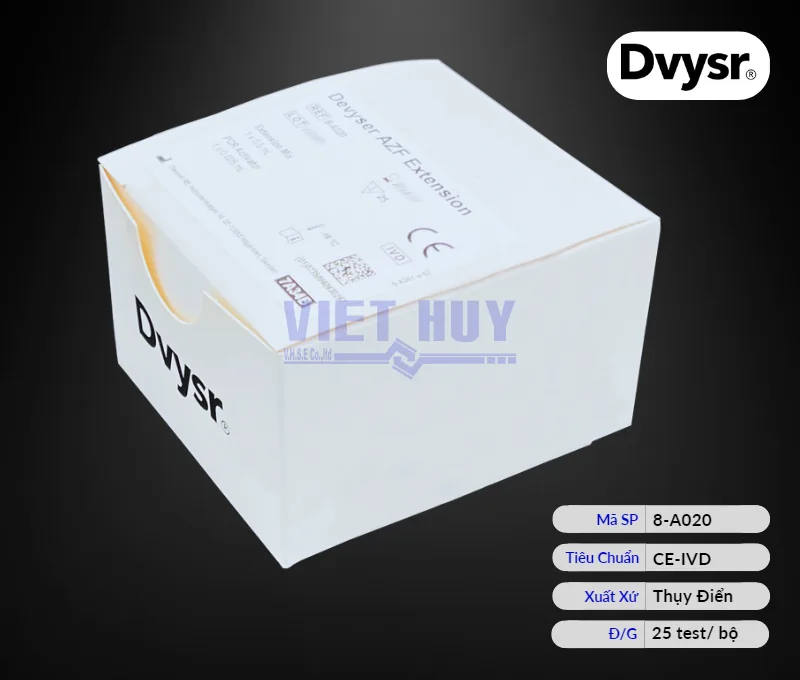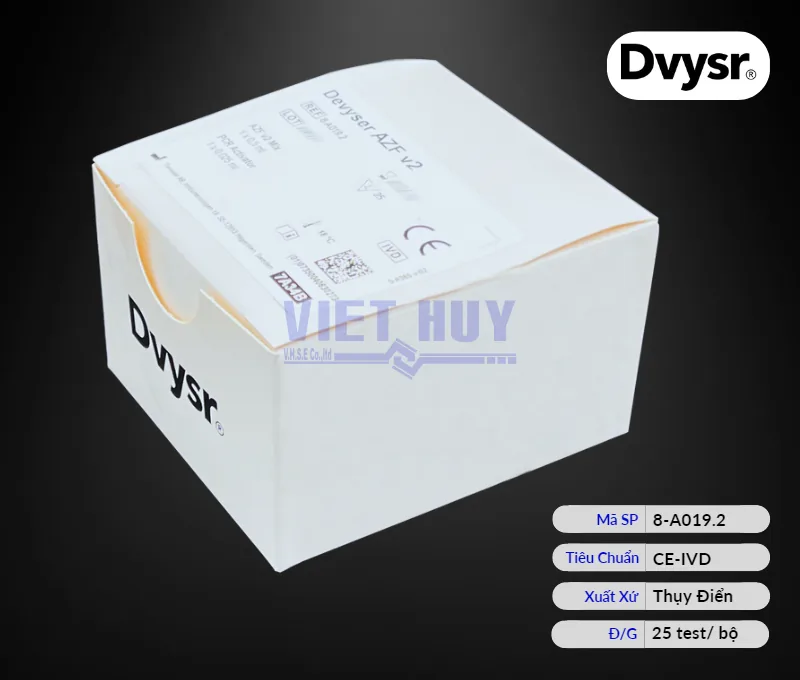
Devyser AZF v2 is a multiplex PCR kit combined with fragment analysis on a capillary electrophoresis system, used to screen for microdeletions in the AZF region on the long arm of the Y chromosome in men with azoospermia or severe oligozoospermia. The kit includes 6 STS markers specific to the three regions AZFa (sY84, sY86), AZFb (sY127, sY134), AZFc (sY254, sY255) and 2 internal control markers, ZFXY and sY14 (SRY gene). This is step 1 of a two-step procedure; when a deletion is detected, the sample is transferred to the Devyser AZF Extension kit to determine the deletion boundaries.
Professional Note
Please read the instructions for use (IFU) carefully before performing the test. Contact a Viet Huy technical specialist for on-site validation support in your laboratory.
AZF microdeletions on the Y chromosome are the second most common genetic cause of impaired spermatogenesis in infertile men, after Klinefelter syndrome. The test is indicated for men with azoospermia or severe oligozoospermia, and is a routine part of the male infertility workup before deciding on a treatment plan. The EAA/EMQN best practice guidelines define the gold standard method for this indication as basic multiplex PCR, followed by extended analysis to determine the deletion boundaries.
The location of the deletion determines the prognosis, which is why the test has clear practical value. Complete deletion of the AZFa region leads to Sertoli cell-only syndrome; complete deletion of the AZFb region leads to spermatogenic maturation arrest. In both cases, the chance of retrieving sperm by testicular microsurgery (micro-TESE) is almost zero. By contrast, AZFc deletions reduce spermatogenesis, but sperm is still present in a significant proportion of cases, so surgical sperm retrieval for ICSI still has a chance of success. The test result therefore helps couples avoid an invasive, costly surgery when the prognosis already clearly indicates it will be unsuccessful.
The test also provides information for genetic counseling regarding the next generation. If the patient carries an AZFc deletion and has a son through ICSI, the son will inherit this deletion intact and is likely to experience similar reproductive problems in adulthood. This information should be discussed with the couple before assisted reproductive techniques are performed.
Contact the Viet Huy technical team for more information.
| `- Number of markers | 8 STS in 1 tube: sY84 (~327bp), sY86 (~317bp) for AZFa; sY127 (~272bp), sY134 (~302bp) for AZFb; sY254 (~376bp), sY255 (~123bp) for AZFc; ZFXY (~438bp) and sY14/SRY (~464bp) as internal controls. |
| Technology | Multiplex PCR + fragment analysis on capillary electrophoresis. |
| Sample source | Whole blood - the only sample type validated for CE-IVD. |
| DNA requirements | Concentration 10-60 ng/µL; add 5 µL/well (50-300 ng DNA); total reaction volume 25 µL. |
| Validated DNA extraction kits | QIAamp DNA Blood Mini, QIAamp DNA Blood Mini QIAcube, QIAsymphony DSP DNA Midi. |
| Electrophoresis instruments | ABI 3130 (POP-7, 36cm), 3500 (POP-7, 50cm), 3730 (POP-7, 36cm), SeqStudio (POP-1, 28cm). |
| Size standard and dye set | 560 SIZER ORANGE (8-R402); DEV-5 MultiCap dye set (8-R401). |
| Analysis software | GeneMapper v4, v5, v6. |
| Performance | Sensitivity >97%; specificity >99%; within-lot repeatability >98% (48 replicates); between lots >99% (110 replicates, 3 rounds). |
| Instrument equivalence | ABI 3500 vs. SeqStudio: 100% concordance; Veriti vs. VeritiPro: 100% concordance. |
Coming soon